Rebuilding the page where every FanCode journey ends up — so that AI-led storytelling tells fans why a match matters, distractions disappear before conversion, and the right content surfaces for every entitlement at every match state.
FanCode 2.0 was a platform-wide commitment to the video-first vision — leveraging the core moat of exclusive live sports rights, cutting operational overhead from secondary initiatives, and creating a consistent, sport-specific discovery experience that uses AI-led thinking and storytelling to drive users toward premium video. The Match Detail Page (MDP) is where that vision had to land hardest: it's the surface where fans watch, check scores, follow squads — and decide whether to pay.
The old MDP failed to leverage FanCode's video-first positioning. A significant cohort of regular visitors — especially repeat non-transactors — consumed peripheral content like scores and commentary without ever engaging with the premium video offering. The page made them derive match context themselves, never communicated the PPV model, and gave marketing nothing to work with.
Regular visitors checked scores and commentary on every match day — and never converted. The page served their free habit instead of selling the live experience that sat one tap away.
The page lacked compelling match context and urgency mechanisms. Users had to work out why this match matters from a scorecard — the platform never told them.
FanCode's unique pay-per-view passes for individual matches and tours — its key differentiation from subscription-only competitors — were never clearly communicated on the page.
Inconsistent touchpoints across sports and journeys created maintenance overhead, and the design couldn't support marketing's need for flexible, event-driven promotions aligned with FC 2.0's configurable approach.
Transform the MDP into a video-first, storytelling-powered conversion engine that immediately communicates match importance and viewing motivation, positions one-time match and tour passes as the primary value proposition, and supports marketing-driven promotion — consistently across sports, match states and user cohorts. Success: a higher match detail → payment listing → order success funnel.
Before any screen was drawn, we agreed the principles that would arbitrate every layout debate. Each one is a testable rule, not a poster slogan — any component that violated one was cut or moved.
The MDP is the top of the payment funnel, not a content hub. Every unit must earn its place by moving a non-entitled user toward a pass — the reason-to-watch block, the live score tease and the persistent GET A PASS bar all exist to feed payment listing.
Pre-match and live, a non-entitled user sees no other content discovery — no related videos, no similar tours, no other matches. Nothing on the page competes with the one decision that matters: watch this match.
What the page shows is keyed to who you are and where the match is. Once the match ends, highlights, match moments and discovery open up for everyone — regardless of entitlement — because post-match, discovery is the conversion path to the next match.
| Match state | Non-entitled user sees | Entitled user sees | Content discovery |
|---|---|---|---|
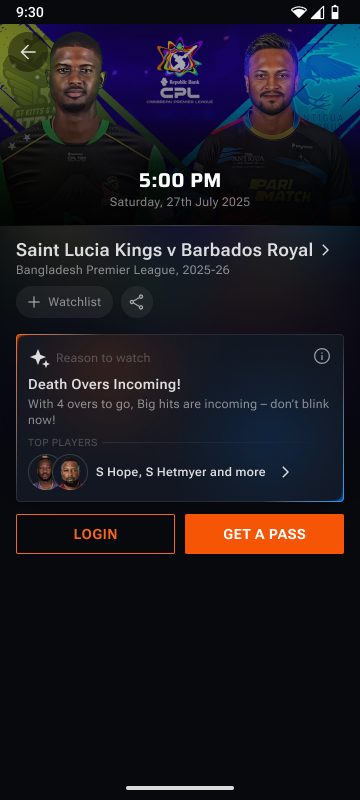
| Pre match | Start time, AI reason-to-watch, top players, LOGIN / GET A PASS | Countdown to stream, AI reason-to-watch, squads & standings sheets | ✕ Hidden for non-entitled — nothing competes with the pass decision |
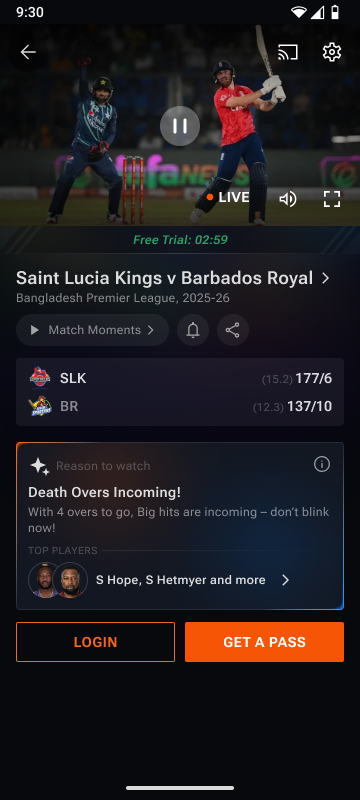
| Live | Free-trial video with countdown, live score, AI storytelling, GET A PASS | Full video player, score, match moments and sheets | ✕ Hidden pre-conversion — the match is the only story on the page |
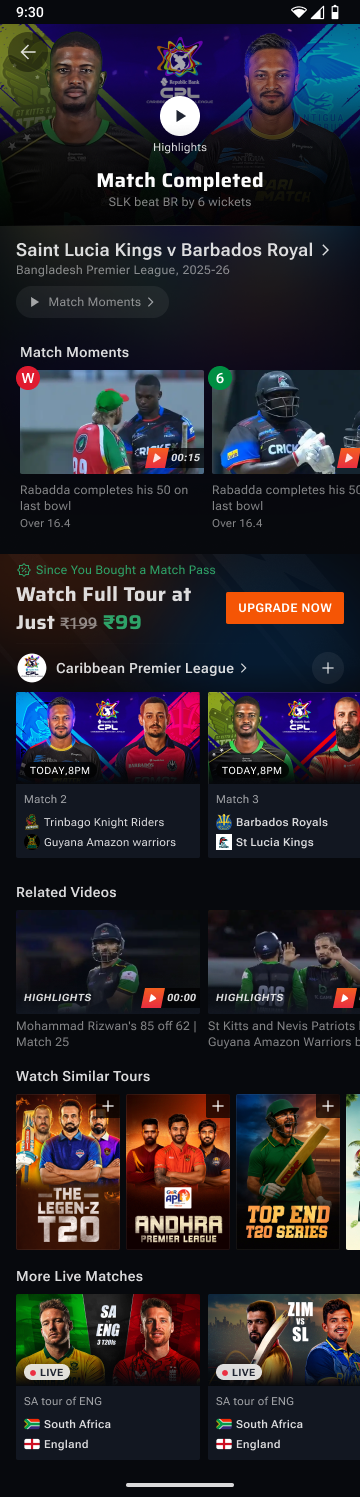
| Post match | Highlights · match moments · related videos · similar tours · more live matches | ✓ Open for all — discovery becomes the funnel to the next match | |


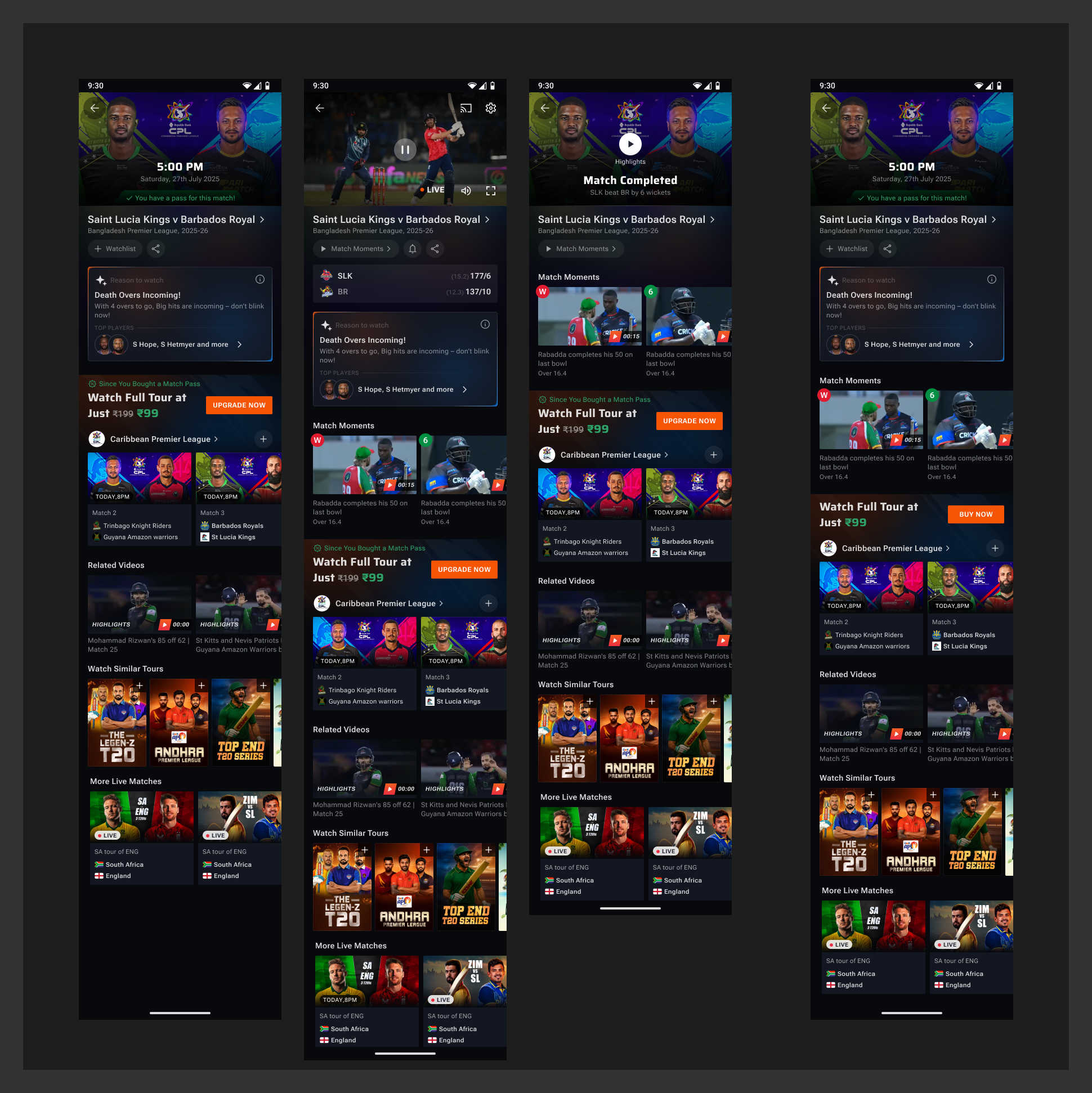
Side by side, the philosophy is visible. Pre-match, the non-entitled MDP is deliberately sparse: match identity, an AI-written reason to watch, the marquee players — then LOGIN and GET A PASS. There is nowhere else to go.
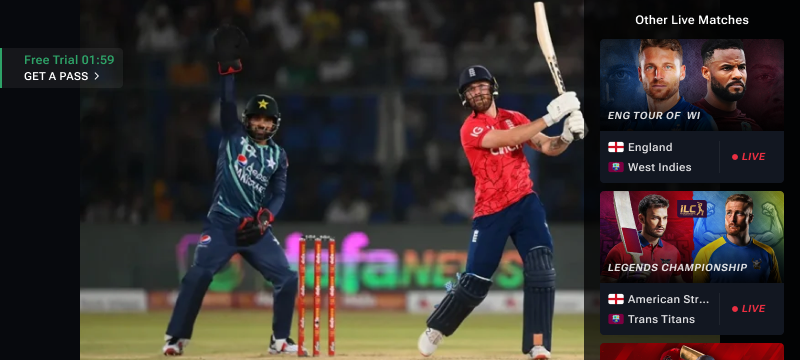
The moment the match completes, the page inverts: highlights up top, match moments, a contextual tour upsell, related videos, similar tours and more live matches. Discovery isn't a distraction any more — it is the next conversion.
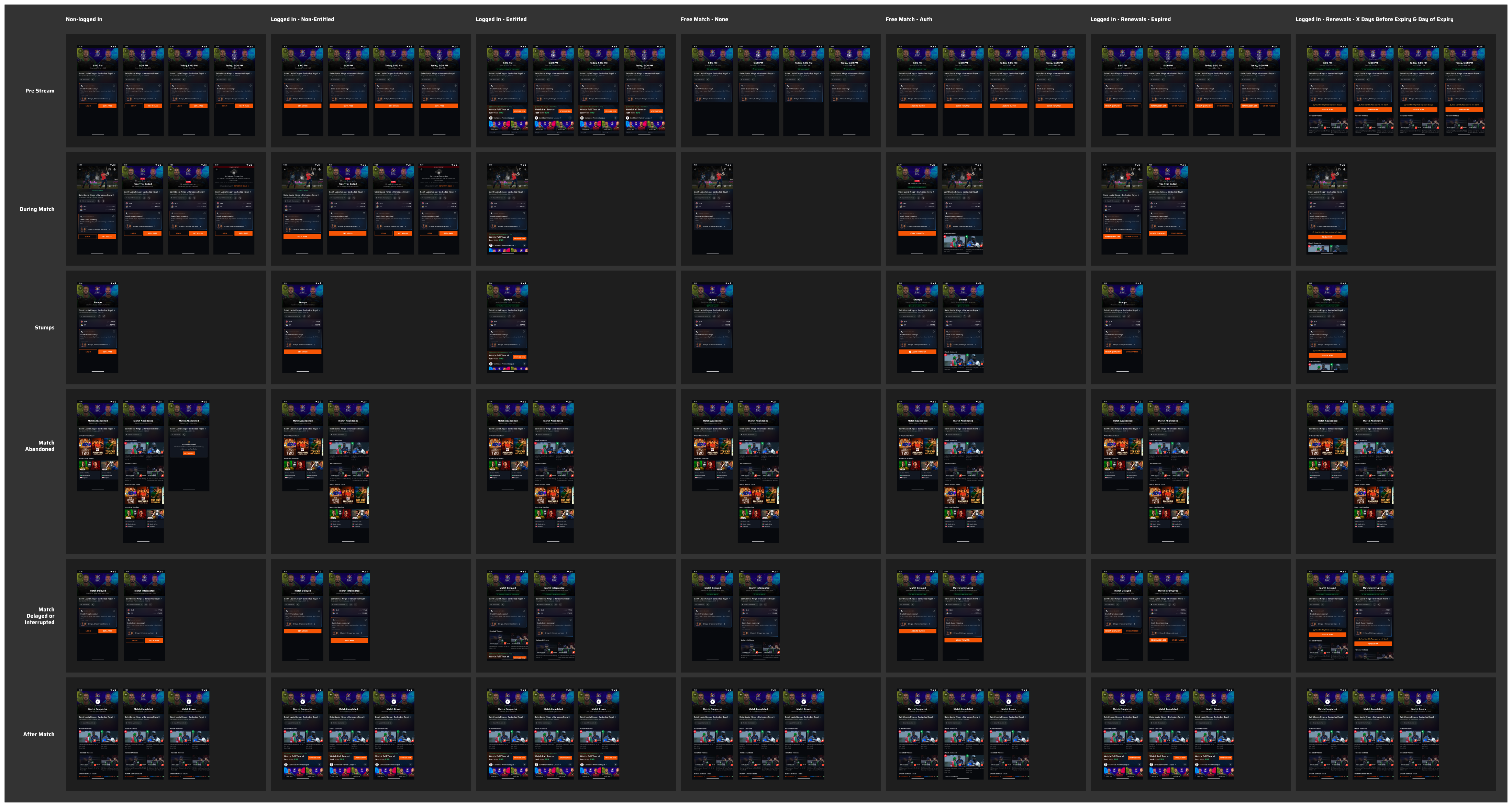
The MDP had to serve a casual fan three minutes into a free trial and a subscriber catching up post-race — without becoming two different products. Every combination of user entitlement (non-logged-in, logged-in non-entitled, match pass, tour pass, subscription, free match, expired) and match phase (pre, live, stumps, delayed, post) was mapped before visual design began.


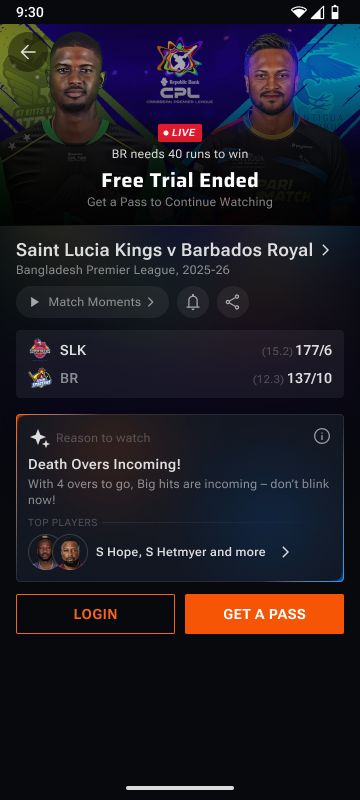
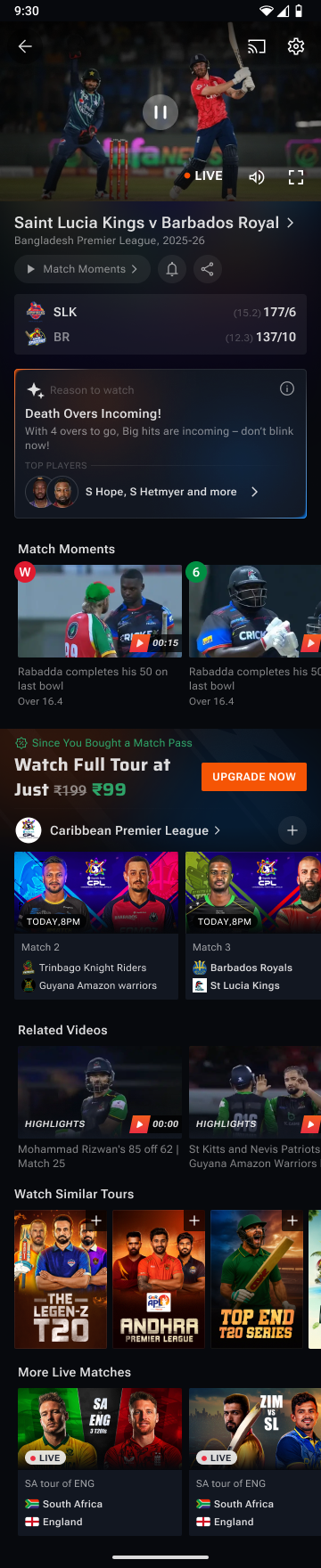
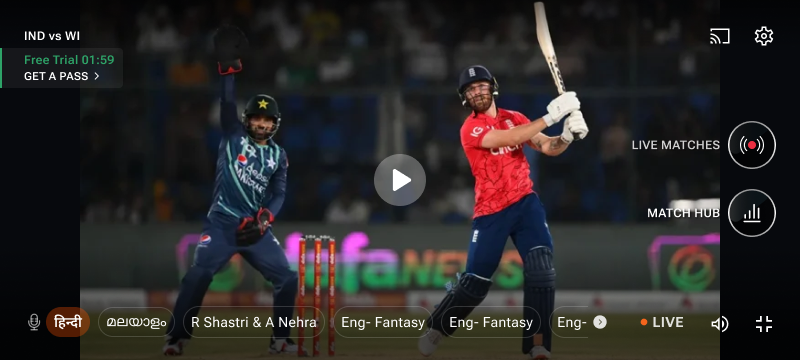
The free trial is the sharpest conversion mechanic on the page: the video starts playing immediately with a visible countdown ("Free Trial 02:59"), so the user experiences the product before being asked to pay. When the trial ends, the message is match-aware — "BR needs 40 runs to win — Get a Pass to continue watching" — urgency drawn from the live game itself, not a generic paywall.
The centrepiece of the conversion-first MDP is the AI summary unit — a glowing block that tells a fan, in one persuasive line, why this match is worth their money right now. It replaces the old expectation that users would derive context from scorecards and commentary on their own.
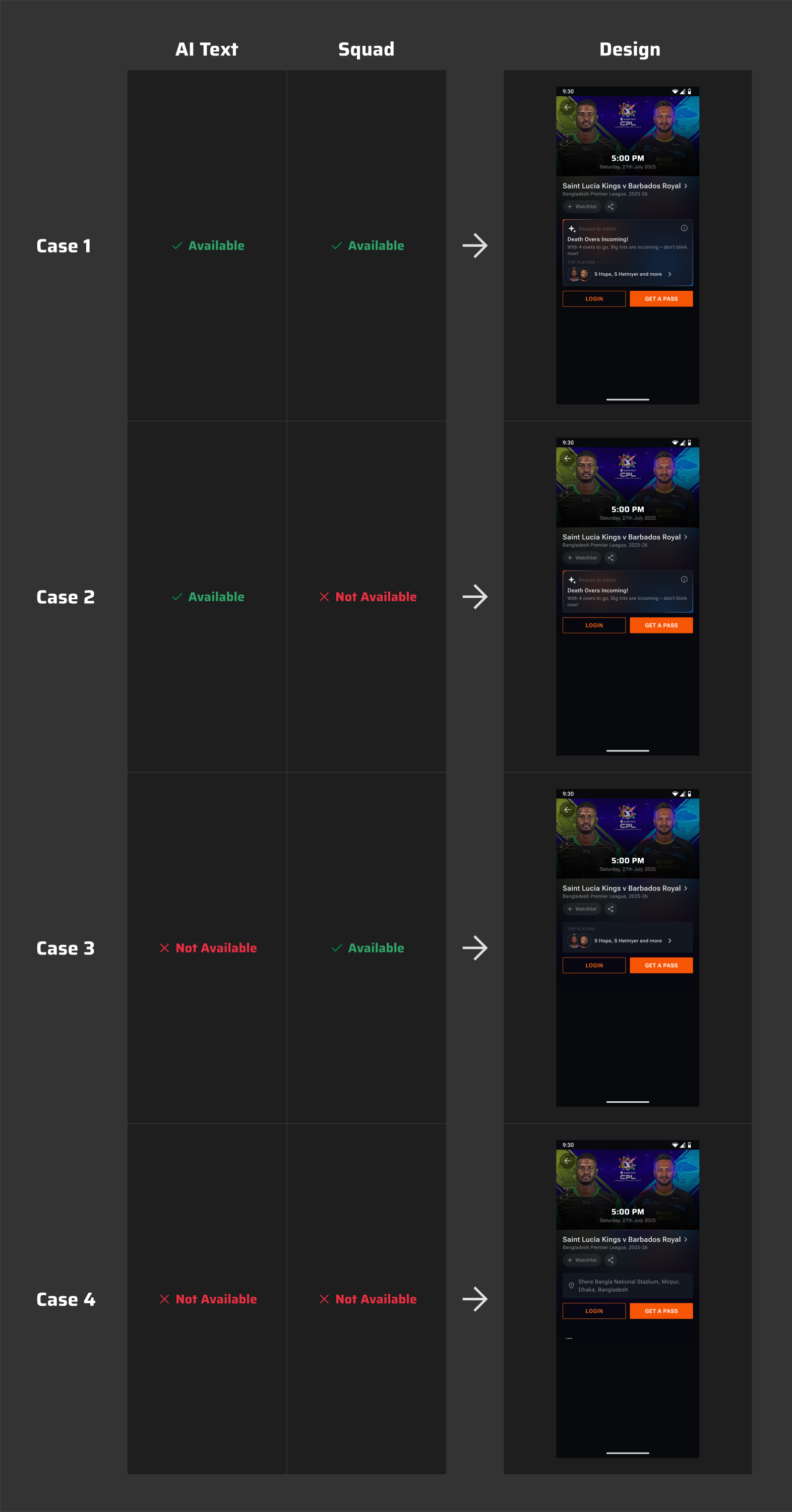
An AI unit that sometimes has nothing to say can't just vanish — that trains users to ignore it. Every combination of AI text and squad availability was designed as an explicit case, so the block always feels intentional.
The first-time appearance animates in with a glowing border and typewriter text; refreshes are deliberately quieter so live updates inform rather than interrupt.
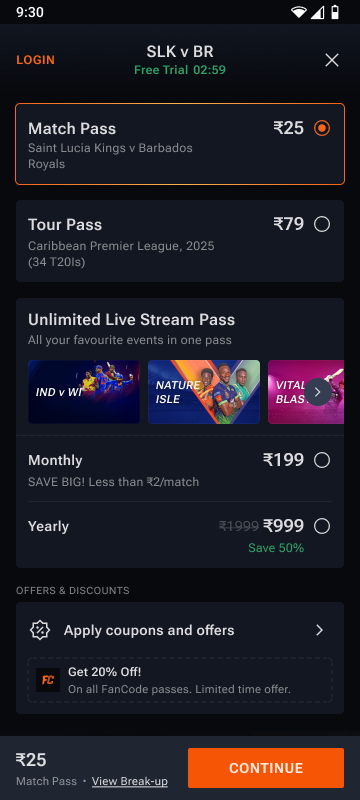
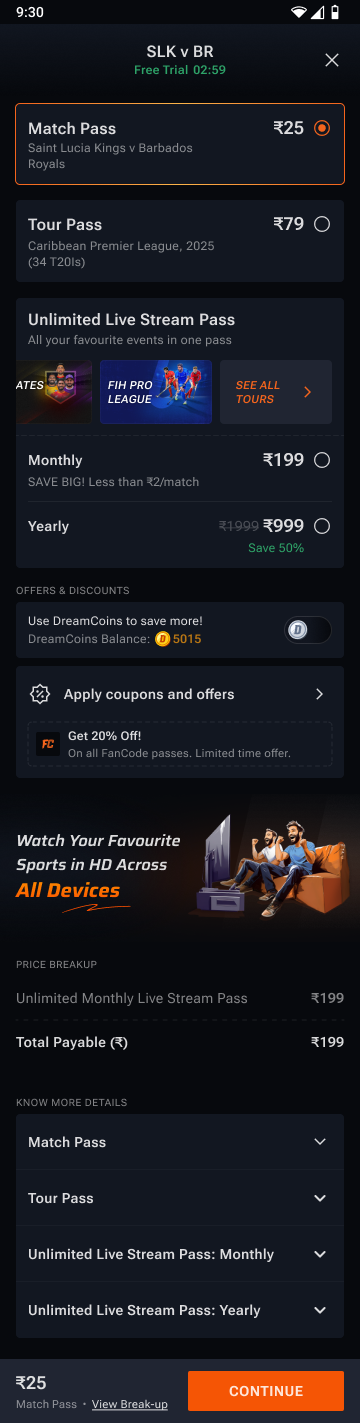
FanCode's differentiation is that you don't need a subscription — you can buy just this match. The payment listing leads with that: a ₹25 match pass at the top of the ladder, the tour pass next, and unlimited passes presented as the value upgrade, never the default. The free-trial countdown follows the user into the listing so the urgency carries through checkout.


The listing stacks options by commitment: Match Pass (₹25) → Tour Pass (₹79) → Monthly (₹199) → Yearly (₹999, "Save 50%"). The selected pass and price stay pinned in the CONTINUE bar, so the user always knows exactly what they're buying.
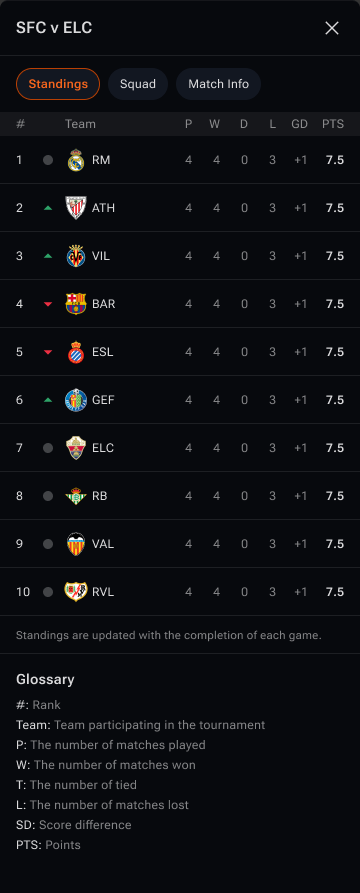
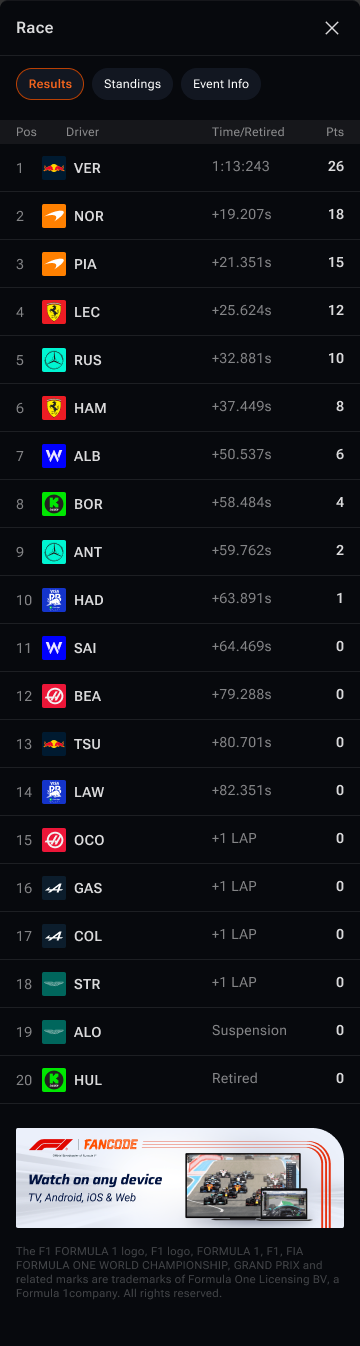
The same principles had to survive fullscreen playback and radically different sports data. In landscape, the free-trial countdown and GET A PASS stay pinned — conversion never leaves the screen. Sport-specific detail lives in bottom sheets (scorecard, squads, standings, race results) so the video-first surface stays identical across sports.


Sports, one chassis. Cricket scorecards, football standings, F1 and MotoGP results all mount into the same sheet architecture — the MDP itself never changes shape.
Scrolls to critical data. Scores, squads and standings are one tap away in sheets — the video stays dominant above, never pushed off-screen by data.
Persistent conversion surface. Portrait, landscape, sheet-open or fullscreen — a non-entitled user is never more than one tap from GET A PASS.
Entitled users arrive via three paths — Match Pass, Tour Pass or Subscription — and each unlocks slightly different affordances handled by one flexible component system. A match-pass holder watching a great game is also the best prospect for a tour pass, so the upgrade unit ("Watch Full Tour at just ₹99") sits in the post-match flow, where the value has just been felt.
Even for paying users, upgrade prompts appear only in context — a Match Pass holder sees the tour upsell inline after match moments, a Tour Pass holder sees the subscription value prop in the feed. No interstitials, no entitlement-blind banners. The AI summary block runs for entitled users too: storytelling keeps them watching, which is its own retention loop.
MDP 2.0 shipped as part of the FC 2.0 platform transformation, with the funnel — match detail → payment listing → order success — as its north-star metric. Beyond conversion, it consolidated fragmented sport-specific layouts into one maintained system and handed marketing a CMS-configurable promotional surface.
Subtraction converts. The boldest call wasn't what we added — it was removing all discovery before conversion. A focused page asks one question; a busy page asks none.
AI needs a content design system. Generated copy is only as good as its instruction set, its review gates and its empty states. The case matrix mattered as much as the model.
State mapping before pixels. The entitlement × match-state matrix built in the UX phase saved weeks in the UI phase — every design debate already had an answer in the spec.